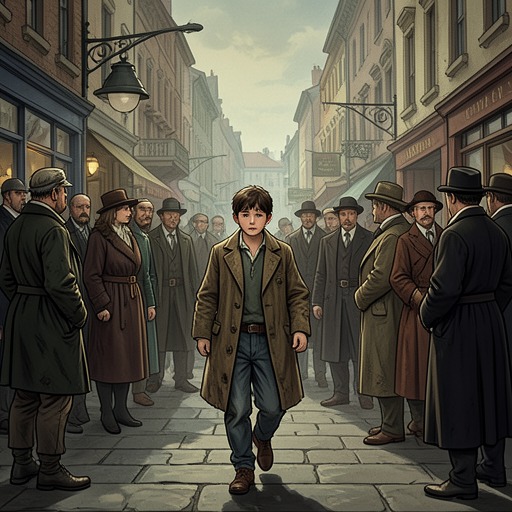
Father repair child's shoe with bicycle tire
Angela's AshesMalachy McCourt’s attempt to mend his children’s shoes with an old bicycle tire is a small domestic episode with consequences that follow them from home to school. He wants to keep them shod; the repair instead makes their poverty conspicuous, complicates their walk, and leaves them exposed to mockery. The shoes thus become more than a practical necessity: they show how care, scarcity, and social stigma can meet in a single, badly fitting solution.
The argument over what can be done
After men have visited the flooded home, Malachy tells Angela McCourt that she should not beg for boots and asks whether she has no pride. Angela answers that the children cannot be allowed to go barefoot. Malachy says he would rather repair their existing shoes, and insists that he can do so when Angela says the shoes are falling apart and that he cannot fix anything. The disagreement sets his personal code of providing for the family against Angela’s immediate concern for what the children need. It also contrasts his resistance to asking for help with the family’s dependence on the possibility of receiving boots from the St. Vincent de Paul Society.
The next day, Malachy returns with an old bicycle tire and sends Frank McCourt to borrow a last and hammer from the next-door neighbor, John Hannon. He cuts the tire with Angela’s sharp knife, shapes pieces for the soles and heels, and nails them onto the shoes. Angela warns that he may destroy them, and points out that the family might receive boots before Easter. Malachy nevertheless covers the soles and heels with rubber, which sticks out beyond the shoes. His effort is concrete and determined, but the repair does not restore the shoes to ordinary use: the rubber makes them lumpy, and the children stumble in them.
The shoes in public
The makeshift footwear carries the family’s hardship beyond the home. Frank returns the borrowed last and hammer to John Hannon; Mrs. Hannon laughs at the shoes, and John shakes his head. Frank feels ashamed and pretends to be sick the next morning because he does not want to go to school. Malachy gets the children up, gives them fried bread and tea, and tells them to be grateful that they have shoes at all, noting that some boys at Leamy’s National School go barefoot in bitter weather.
At school, the repair marks Frank and his brother out. The thick tire pieces add several inches to their apparent height, prompting other boys to tease them. Frank notices that the barefoot boys do not join in. The contrast sharpens the social cost of the repair: having no shoes at least aligns those boys with one another, while the conspicuous rubber soles isolate Frank and his brother. Frank removes his shoes and stockings in the schoolyard shed, but the master knows he is not one of the barefoot pupils and orders him back to retrieve and put on the shoes. The attempt to escape their stigma cannot make the distinction disappear.
The master addresses the class about sneering at other people’s misfortunes and asks whether anyone thinks himself perfect or comes from a rich family with money to spend on shoes. The boys stop bothering Frank and his brother. The episode therefore ends not with the repair being undone, but with a change in how the children around them behave. They continue to wear the tire-patched shoes for the few weeks until Easter, when the St. Vincent de Paul Society gives the family boots.
Care, shame, and material limits
The bicycle tire is both the means of Malachy’s attempted repair and the reason the children cannot wear the shoes unnoticed. It makes visible the constraints surrounding the family’s choices: Malachy has a knife, borrowed tools, and discarded rubber, but no new shoes to offer. His intervention expresses care through labor and resourcefulness; its clumsy result shows that effort cannot remove the underlying shortage. Angela’s preference to preserve the shoes and wait for charitable boots likewise reflects a practical calculation, not indifference to the children’s need.
The episode places the children’s experience alongside other forms of family responsibility in the book. Elsewhere, Frank and Malachy prepare sugar water and food for the hungry twins when Angela remains in bed, and Frank carries newspapers for his uncle and helps John Hannon deliver coal. These episodes show children taking on practical work amid adult hardship; the patched shoes make that hardship visible on their own bodies and shape their passage through school. Later, as a temporary telegram boy, Frank encounters another sharp divide between insecure work and permanent employment: the permanent boys have uniforms, waterproof capes, and holidays, while temporary boys have none. Across these situations, a lack of money is not merely stated; it determines what the children wear, do, and can expect from institutions.
The shoe-repair episode also complicates a simple opposition between accepting help and preserving pride. Malachy objects to begging, yet the repair fails to provide the ordinary protection and dignity he wants for his children. The charity boots that arrive weeks later accomplish what the rubber could not. Until then, the children must wear the evidence of scarcity, while a teacher’s intervention briefly alters the response it draws from their classmates.